Structural Condition
Deck Moisture and Soft Spots: What Yacht Buyers Should Know
Moisture inside a cored yacht deck can remain hidden beneath the surface. Understanding how water enters the structure, the warning signs to look for and the limits of survey testing can help buyers make better-informed decisions.
Introduction
Many GRP yacht decks use sandwich construction. A lightweight core material is bonded between inner and outer laminate skins to increase stiffness without excessive weight.
When water passes through poorly sealed fittings, damaged laminate or previous repair areas, it may enter the core.
The visible deck surface can still appear acceptable even when moisture is present below it.
- Moisture does not automatically mean that the deck has lost structural strength.
- A soft area does not automatically identify the full extent or cause.
- Findings must be interpreted together with construction, location, history and other inspection evidence.
1. Why Moisture in a Yacht Deck Matters
Prolonged moisture may contribute to:
- Core deterioration
- Loss of adhesion between the core and laminate skins
- Localised delamination
- Reduced panel stiffness
- Movement around deck fittings
- Freeze-related deterioration in colder climates
- Corrosion of embedded or nearby metal components
- Larger and more complex future repairs
The significance depends on the core material, duration of exposure, affected area, loading, construction quality and whether the laminate remains securely bonded.
Wet core does not automatically mean that every affected area must be replaced. The evidence and the yacht’s construction must be assessed together.
2. How Moisture Enters Cored Decks
Water commonly enters around penetrations or fittings where sealing has failed, aged or been disturbed. Potential entry points include:
- Stanchion bases
- Cleats and fairleads
- Chainplates
- Hatches
- Windows and portlights
- Mast step and mast partners
- Winches
- Handrails
- Windlass installations
- Deck organisers and blocks
- Ventilation fittings
- Previous screw holes
- Added equipment
- Poorly executed repairs
- Cracks or impact damage
The visible leak point and the moisture concentration may not be in the same place because water can migrate through voids, fastener holes or damaged core.
3. Warning Signs Buyers Can Look For
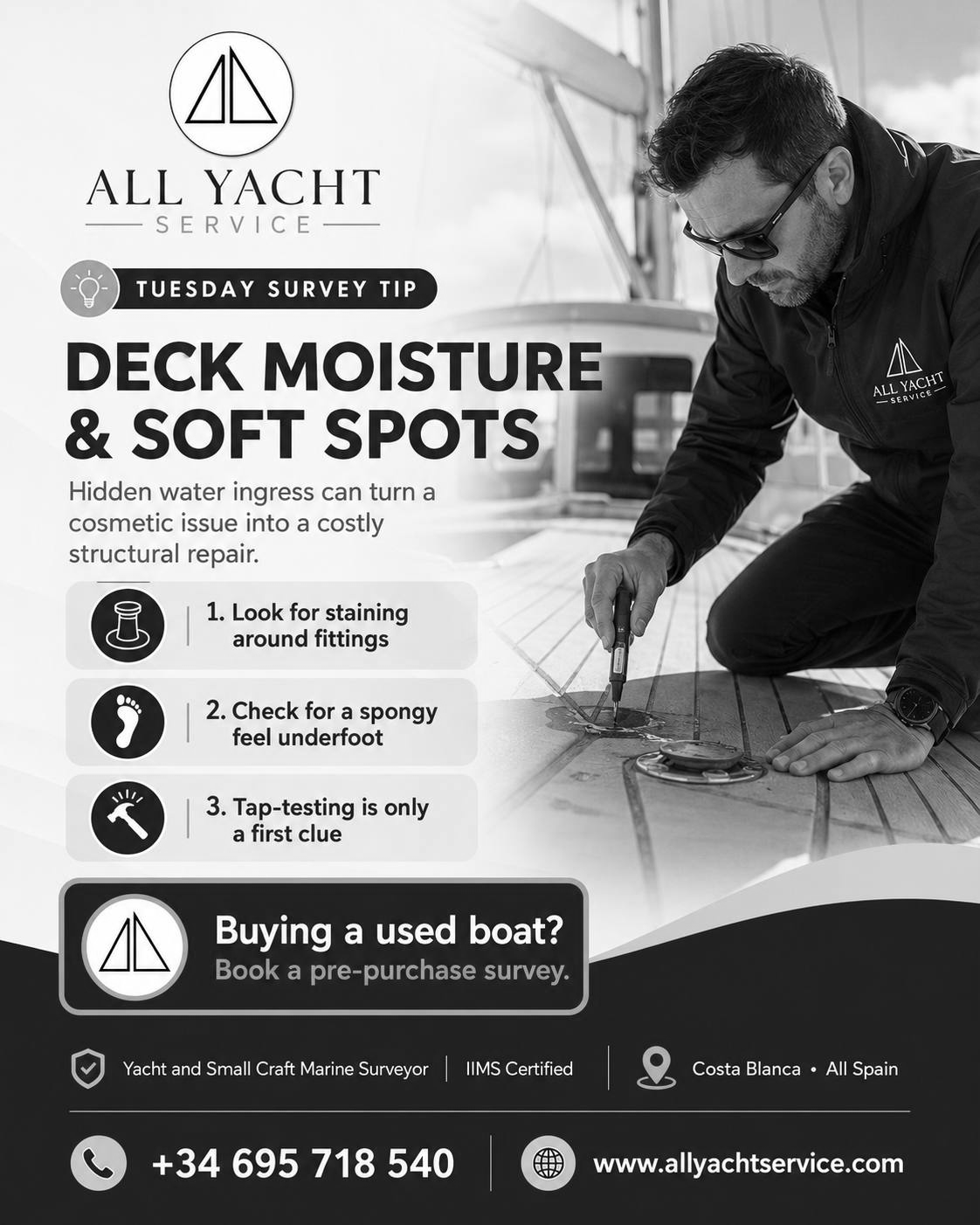
- Staining beneath deck fittings
- Water marks inside lockers or headlining
- Cracked, shrinking or detached sealant
- Corrosion around fasteners
- Local surface cracking
- A soft or spongy feeling underfoot
- Local movement around fittings
- A change in sound when the deck is lightly tapped
- Depressions around heavily loaded fittings
- Repeated interior leaks
- Previous repairs without supporting documentation
These signs justify further investigation, but none of them alone confirms the construction, depth or full extent of damage.
Buyers should not use aggressive tapping, drilling or other destructive testing. These methods can damage the yacht and should only be considered within an authorised professional inspection.
4. What Does a Soft Deck Area Mean?
A soft or flexible area may indicate:
- Deteriorated core
- Loss of bonding
- Local delamination
- Inadequate original support
- Previous repair
- Thin or flexible construction
- Movement around a loaded fitting
Some deck areas are naturally more flexible than others. A meaningful assessment requires comparison with surrounding construction and an understanding of the yacht’s design.
5. How a Yacht Surveyor Investigates Suspected Moisture
A surveyor combines inspection methods and compares the results with the yacht’s construction, surrounding areas and available history. No single method is treated as a complete diagnosis.
Visual Inspection
The surveyor examines accessible areas for evidence that may identify an entry point, previous intervention or a change in local condition.
- Sealant condition
- Fittings
- Fasteners
- Cracks
- Surface distortion
- Interior staining
- Previous repairs
- Accessible underside structure
Percussion or Tap Testing
Light comparative tapping may help identify changes in acoustic response associated with differences in bonding, laminate thickness or core condition.
Limitations
- The method is comparative.
- Results depend on construction and access.
- Different sounds do not automatically prove wet core.
- Heavy decorative finishes may reduce usefulness.
Moisture Meter Readings
A moisture meter can provide comparative readings across the deck and help identify patterns requiring further investigation.
Limitations
- Readings are not a direct measurement of percentage water inside every laminate.
- Metal, carbon fibre, wiring, tanks, fittings and other conductive materials can influence readings.
- Salt contamination can influence readings.
- Surface moisture and recent rain can influence readings.
- Antifouling, coatings and different laminate thicknesses may affect interpretation.
- Readings must be compared with reference areas and other evidence.
Thermal Imaging
Where conditions are suitable, thermal imaging may help identify temperature patterns that support further investigation.
Limitations
- Results depend on environmental conditions.
- Solar heating, wind, recent rain and internal heat sources affect images.
- Thermal imaging should not be treated as a standalone diagnosis.
Inspection From Below
Where accessible, the surveyor checks the underside of the deck and adjacent interior areas for supporting evidence.
- Headlining
- Lockers
- Deck underside
- Backing plates
- Fasteners
- Structural supports
- Interior staining
- Local repairs
Further Investigation
Controlled opening, core sampling or dismantling may be recommended where confirmation is needed and the commissioning client authorises destructive investigation.
- The suspected area is significant.
- Structural loading is involved.
- The findings are inconsistent.
- Repair planning requires confirmation.
- The commissioning client authorises destructive investigation.
Limitations
- Destructive testing is not automatically included in a normal pre-purchase survey.
6. Why Moisture-Meter Numbers Need Context
Buyers should not make a purchase decision from one isolated number. Interpretation should consider:
- Meter type and scale
- Reference readings
- Construction material
- Core type
- Surface condition
- Weather before inspection
- Nearby metal or wiring
- Pattern and extent
- Visual evidence
- Tap-test findings
- Movement
- Interior evidence
- Vessel history
7. Does Moisture Always Mean an Expensive Repair?
Not necessarily.
The outcome may range from:
- Monitoring and resealing
- Removing and rebedding a fitting
- Local drying and repair
- Localised core replacement
- Wider laminate and core reconstruction
The required response depends on:
- Moisture source
- Core condition
- Bonding
- Structural loading
- Size of the affected area
- Access
- Previous repairs
- Repair quality expected
- Whether the moisture source has been stopped
A repair scope should be developed for the individual yacht after the affected construction has been assessed. Generic prices would not provide a reliable guide.
8. What Yacht Buyers Should Do
Do not rely only on appearance
A clean deck surface does not confirm the condition of the core below it.
Review the yacht’s history
Ask about previous leaks, deck repairs, fitting replacement, mast-step work and insurance claims.
Ensure the deck is accessible
Personal equipment, covers and stored items should be removed before inspection where practical.
Arrange appropriate inspection conditions
Recent rain, washing or heavy surface moisture may affect some testing.
Ask for findings to be explained in context
Request clarification of location, extent, evidence and recommended next steps.
Obtain repair information where necessary
For material findings, obtain an appropriate repair proposal before completing the purchase.
Use the survey findings in the purchase decision
Consider safety, urgency, future maintenance, repair access and cost—not only the presence of moisture.
9. Questions to Ask After Moisture Is Found
- Where is the suspected moisture located?
- How large is the affected area?
- What evidence supports the finding?
- Is movement or loss of stiffness present?
- Is the area structurally loaded?
- What is the likely entry point?
- Is the source still active?
- Is further testing recommended?
- Should a repair specialist inspect the area?
- Does the finding affect immediate use?
- Is the repair likely to be local or wider?
- What limitations affected the inspection?
10. Surveyor’s Key Point
11. When to Arrange a Professional Survey
A professional pre-purchase yacht survey is particularly valuable when:
- Buying an older GRP yacht
- Deck fittings show signs of leakage
- Soft areas are noticed
- Repairs are visible but undocumented
- The mast step or chainplate areas show staining
- The yacht has extensive deck hardware
- The vessel has been stored outdoors for long periods
- The buyer cannot confidently interpret inspection findings
Structural Condition
More Yacht Survey Tips
Browse practical guidance about yacht condition, common defects and survey preparation.
Pre-purchase support
Buying a Yacht With Suspected Deck Moisture?
All Yacht Service can inspect the yacht’s accessible deck structure, fittings and related areas as part of an agreed pre-purchase survey scope. Send us the yacht details and location to discuss the inspection.