
Pre-Purchase Checks · Hull & Structure
Can You Trust a Shiny Hull? What Used-Yacht Buyers Should Check
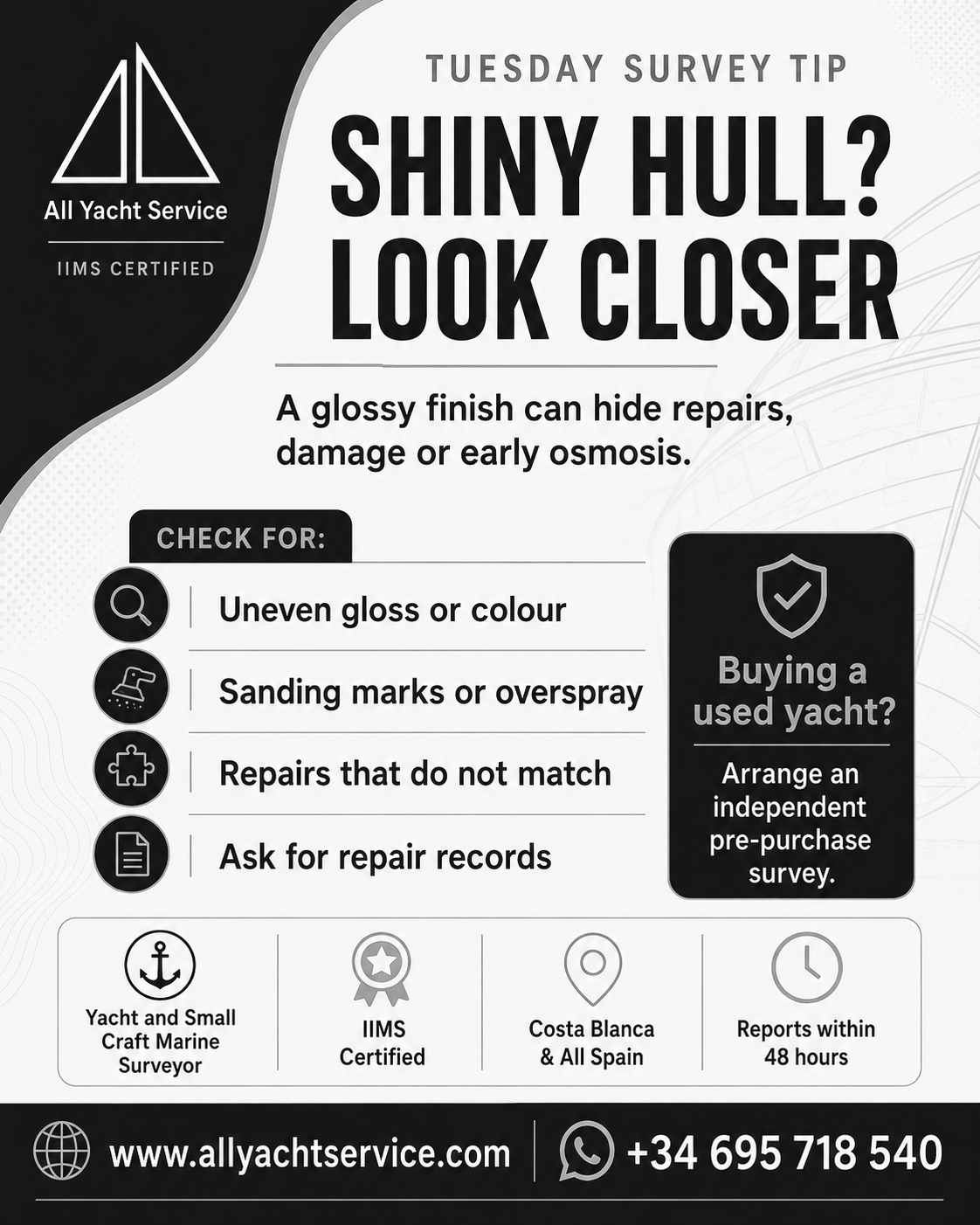
A glossy finish creates a strong first impression, but it does not confirm what lies beneath. Differences in colour, reflection, fairness or repair quality may justify closer investigation before buying a used yacht.
Introduction
A freshly polished or recently painted yacht can make an excellent first impression. Clean topsides, deep gloss and an apparently flawless surface may suggest that the yacht has been carefully maintained.
However, cosmetic presentation and technical condition are not the same thing.
Polishing, paintwork and local surface repairs can improve the appearance of a yacht without explaining what has happened underneath. Previous impact damage, gelcoat repairs, cracking, laminate work or moisture-related problems may not be obvious during an ordinary viewing.
This does not mean that every shiny yacht is hiding a problem. Appearance should be treated as only one part of the inspection.
Why a Glossy Finish Can Be Misleading
A professional polish can temporarily reduce the visibility of faded gelcoat, light oxidation and minor surface marks. A new paint finish can also cover previous colour differences, repaired areas and small imperfections.
New coatings or local refinishing may conceal evidence of:
- Previous repairs
- Filler
- Impact damage
- Blister treatment
- Fairing work
- Other previous hull work
Below the waterline, recently applied antifouling may make the underwater hull look clean and uniform while limiting the buyer’s ability to see older blistering, filling or repair work.
None of these treatments is automatically suspicious. Regular polishing, painting and antifouling are normal parts of yacht maintenance. A glossy finish does not prove hidden damage. The important question is whether the work was routine or followed damage or deterioration.
Signs of Possible Previous Hull Repairs
Differences in finish, reflection or fairness may justify closer investigation. They should be assessed comparatively and in the context of the yacht’s construction and history.
Uneven Gloss or Colour
Look along the hull from different angles rather than standing directly in front of it.
Local differences in colour, reflection or gloss may indicate that one section has been painted, polished or repaired separately from the surrounding area. This can be especially noticeable in strong natural light.
Colour differences do not prove that a repair is defective, but they justify asking for more information.
Waviness or Changes in Hull Fairness
A hull surface should normally appear smooth and fair when viewed along its length.
Local hollows, raised areas, distortion or changes in reflection may justify closer investigation.
- Filler beneath the coating
- Previous impact repairs
- Laminate work
- Poor surface preparation
- Local deformation
Some construction marks are normal, particularly on older yachts, so these signs must be interpreted in context.
Sanding Marks, Masking Lines or Overspray
Visible sanding scratches, paint on fittings, sharp masking edges or overspray can suggest that refinishing work was completed quickly or locally.
The quality of the finish may also provide an indication of the care taken during the underlying repair.
- Windows
- Rubbing strakes
- Through-hull fittings
- Deck-to-hull joints
- Exhaust outlets
- Transom fittings
- Decals and registration markings
Repairs That Do Not Match the Surrounding Surface
Differences in gelcoat texture, paint thickness, surface profile or finish can identify areas where work has previously been completed.
Pay particular attention around locations where impact, grounding, loading or water ingress may occur.
- Bow
- Stern quarters
- Keel area
- Rudder
- Chainplates
- Stanchion bases
- Lifting points
- Areas close to fenders and marina contact points
Cracking Around Structural or Loaded Areas
Small cracks are not all equal.
Fine cosmetic crazing in ageing gelcoat may be relatively superficial, while cracks around the keel, bulkheads, chainplates, mast support, rudder or deck fittings may require closer investigation.
The location, direction and pattern of cracking are often more important than the crack width alone.
Questions to Ask the Seller
Before making an offer, ask for the purpose, scope and records of previous work:
- Has the hull ever been involved in a collision, grounding or other impact event?
- Have any areas of the hull been re-laminated, filled or faired?
- When were the topsides last painted or extensively polished?
- Why was the repainting, refinishing or repair work carried out?
- Who completed the work?
- Has the yacht had previous moisture, blister or osmosis treatment?
- Were any insurance claims connected with the work?
- Are invoices, repair photographs or technical reports available?
- Is documentation available from the repair yard or insurer?
A well-documented professional repair is not necessarily a reason to reject a yacht. The concern is greater when significant work appears to have been completed but no explanation or documentation is available.
A Safe DIY Check During the First Viewing
A buyer’s initial inspection should identify questions and warning signs—not attempt to replace a professional survey.
- Inspect the hull from different angles.
- Look along the hull rather than only directly at it.
- Observe how reflections travel across the surface.
- Use natural or directional light.
- Compare the port and starboard sides.
- Inspect transitions around areas that appear repaired.
- Look for inconsistent colour, gloss, shape or finish.
- Check for visible masking boundaries, sanding marks or overspray.
- Record observations for discussion with a surveyor.
What buyers should not do
- Scrape coatings
- Drill holes
- Remove fittings
- Damage the surface
- Perform aggressive percussion testing
- Carry out destructive investigation without permission
What a Professional Survey Adds
A pre-purchase survey considers the hull as part of the yacht’s complete structure rather than judging the finish in isolation. Depending on the yacht, construction and agreed scope, it may combine:
- Close visual inspection of the topsides and underwater hull
- Comparative assessment of port, starboard and surrounding surfaces
- Examination of reflections and hull fairness
- Inspection of accessible internal structures, bulkheads and connections
- Review of visible repairs
- Percussion testing where appropriate
- Moisture assessment interpreted in context where appropriate
- Review of available repair, yard and insurance documentation
- Haul-out inspection of the underwater hull, keel, rudder and fittings
- Recommendations for specialist or destructive investigation where justified
Moisture-meter readings should not be treated as a simple pass-or-fail result. Coating type, laminate construction, surface condition, temperature and nearby materials can affect readings. Results must be considered with visual findings and vessel construction.
A normal survey cannot find every concealed repair or condition. Specialist or destructive investigation may be recommended where the available evidence justifies it and separate authorisation is obtained.
Why These Findings Matter to a Buyer
Previous repair work is not automatically unacceptable. Important questions include:
- Why the repair was required
- Which structure was affected
- How it was completed
- Which materials were used
- Whether it is documented
- Whether the finish is cosmetic or connected to deeper work
- Whether further investigation is required
- Whether it affects safety, value, maintenance or future resale
A properly completed and documented repair may be acceptable. Poorly documented, inconsistent or technically questionable work may require further investigation before purchase.
Survey findings may help a buyer proceed with confidence, request further investigation, renegotiate or decide that the yacht presents too much risk. The objective is not to find a perfect yacht; it is to understand the yacht being purchased.
Surveyor’s Key Point
Professional Inspection Limitations
- A glossy surface does not prove good condition.
- A glossy surface does not prove concealed damage.
- Colour differences do not automatically prove defective repair.
- A visible repair is not automatically unacceptable.
- Visual inspection cannot confirm every concealed condition.
- Normal surveys are generally visual and non-destructive.
- Specialist or destructive examination may require separate authorisation.
- Findings must be interpreted in context.
Pre-Purchase Checks · Hull & Structure
More Yacht Survey Tips
Continue with related buyer guidance or browse the complete knowledge hub.
Pre-purchase support
Buying a Used Yacht?
A professional pre-purchase survey can help identify visible signs of previous repairs, assess accessible structure and systems, review available documentation and explain where further investigation may be appropriate.